philosophy
Philosophy of the artist.
An attempt at rapprochement.
"Möseneder's abstraction is the realism of a dream vision, a premonition of the new, a longing for beauty. This form of abstraction seeks not superficial statements, but subtle hints."
- by Mag. Peter Allmaier, theologian
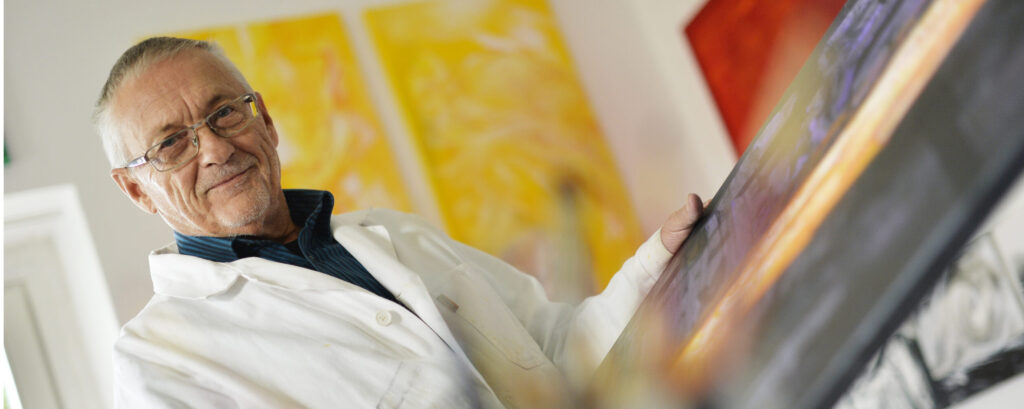
The characteristics of the artist
Modern Art
The artist stands out in the modern art scene through his experimental techniques and masterful combination of colors and materials. Whether acrylic, oil, plaster, or bronze, his works are versatile yet unique. Through his ability to combine tradition and innovation, he creates timeless works of art that fascinate both aesthetically and intellectually.
Spiritual Art
Möseneder's spiritual works are characterized by a deep connection to transcendence and the divine. His art reflects universal themes such as creation, transformation, and hope, often in symbolic color compositions and forms. The balance between abstraction and recognizable symbols invites the viewer to meditatively engage with life's deeper questions.
Nude Art
Heinz Möseneder masterfully captures the essence of humanity and the sensual in his works. His depiction of Eros is subtle yet powerful, capturing the dynamics of the body, the grace of forms, and the tension between proximity and distance. In his works, body and emotions merge into a harmonious unity that directly speaks to the viewer.
"What is initially and ultimately revealed in Heinz's paintings is the invisible and unspeakable."
Univ. Doz. Dr. Erik Adam (sociologist, philosopher, educator, Germanist)
“Through the diversely nuanced play of colors, the viewer gains an inkling of the mystery inherent in all living things.”
Heinz Möseneder
The seeing-painting-creative gaze of Heinz Möseneder is, because “erotic”, INCARNATED beyond all divisions, for it occurred at the points of contact between the bodily-founded eye and the perceived-sensing world.
Dr. Erik Adam
Previous
Next

Experts say about his works
Mag. Christian Blasge, MA:
His works are sources of inspiration, hope, and faith. Colorful, powerful, and with a remarkable attention to detail, his images fascinate and constantly remind us that there could be more hidden behind the veil of material existence. Something great, good, incomprehensible to the human mind. His artistic gift has the ability to touch and transform us, to encourage us to look beyond the obvious and recognize the beauty and mystery of life in all its facets. Heinz Möseneder has not only created paintings and sculptures, but also a bridge to a deeper, spiritual level that connects us all and allows us to grow.
Maria Pink:
"The stone began to live in the sculptor's hands. In restrained intimacy, the details merge, striving upward as a whole. This above is not locally limited. Heinz Möseneder leaves all possibilities open into a still unexplored dimension. Transcendence is given scope. The central section of the sculpture radiates tranquility, a place for meditation, flowing into a spiral that begins nowhere and ends nowhere. He trusts his own line. This was the origin, when the first living cell grew out of chaos, and a second joined it; from the two, a unity emerged; from this unity, ultimately, the diversity of life emerged."
Univ. Doz. Dr. Erik Adam:
If we linger in Heinz Möseneder's "landscape paintings" from an erotic perspective, then they make the "flesh of the world", to use this strange formulation by Merleau Ponty, visible and tangible, where seeing and bodily sensation are still inseparable, neither objectifying nor symbolic, but images as METAPHOR FOR METAMORPHOSES - transparent and voluminous at the same time in a female physiognomy luminous from within, matter transformed into mater, a matrix producing manifold forms.
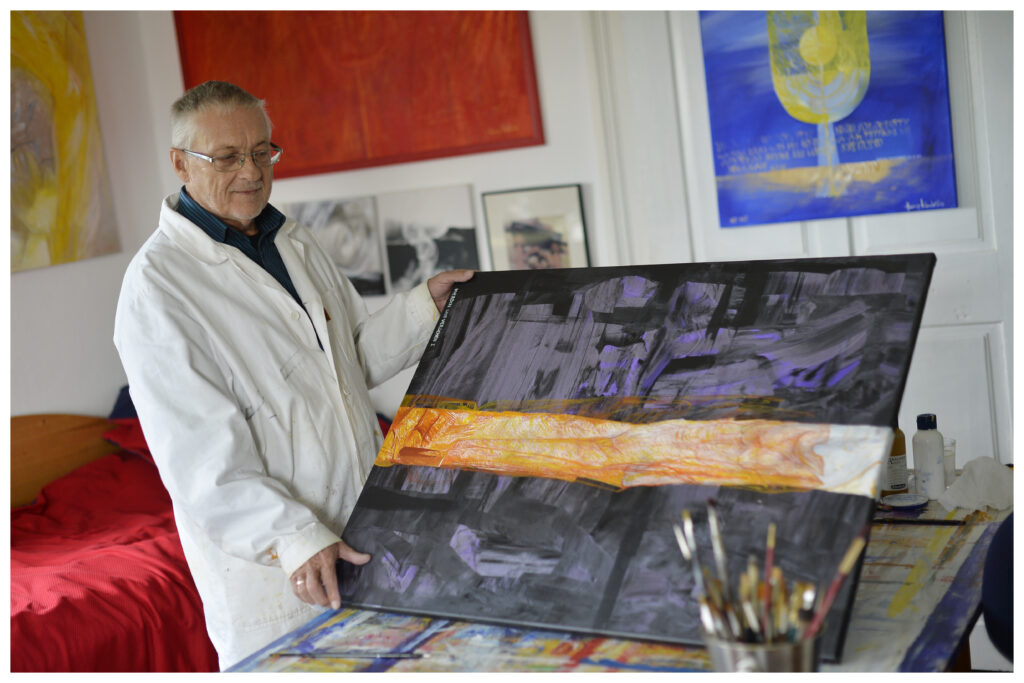
The person behind the paintings
To person
Heinz Möseneder, born on November 10, 1946, in Rohrbach, Upper Austria, lived in Carinthia since 1971, far from the urban art scene. His home and studio were located in Gradenegg, a small village high above Liebenfels. There, he and his wife lived in an old 13th-century rectory, which, with its Gothic vaults, offered a special atmosphere. This place, filled with art, culture, and spiritual depth, became an inspiring retreat that significantly shaped Möseneder's work.
Inspirations:
Life in Gradenegg and the surrounding landscape profoundly influenced Möseneder's art. His works reflect impressions of nature, sometimes as clear atmospheric images, sometimes distorted by the female body. In his art, female nudes become a fusion of nature and eroticism, finding each other in sensual harmony. These depictions exude a special attraction and demonstrate his ability to harmonize nature and humanity.
Travel:
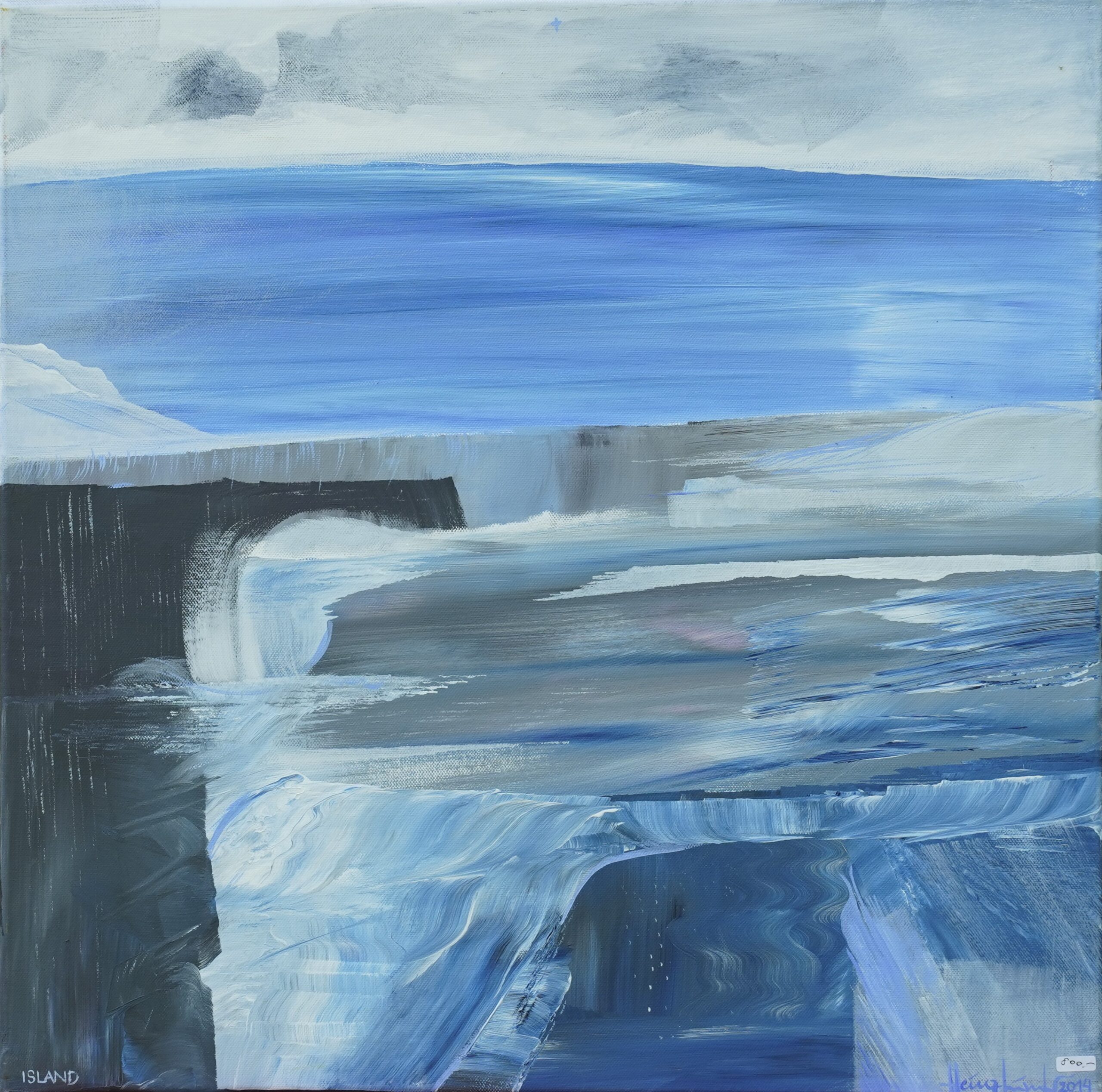
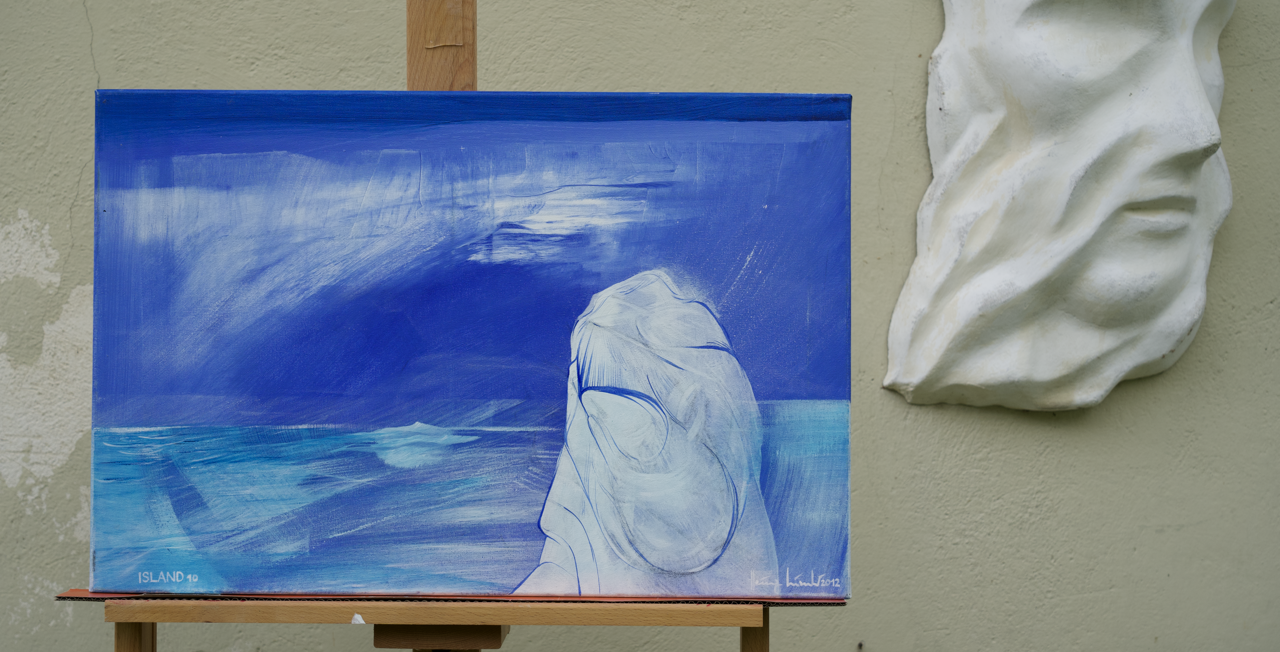
His artistic travels have taken him to Iceland, Ireland, Morocco, Israel, Greece, and other countries. The colors and landscapes of these places are reflected in his works, without evoking longing for distant lands. Instead, they create a familiar atmosphere that transports the viewer to their own inner landscapes. Möseneder knew how to portray the beauty of these foreign places with a keen sense of sensitivity in his works, always discovering new details that continually surprise us.
Are you an exhibitor and interested in the works?
Get in touch with us!
"Transcendence is given scope.
Peace radiates from the center, is a place for meditation
and unexplored dimensions."
Heinz Möseneder
More opinions on Möseneder
"Prof. Möseneder – the human being is at the center of all his work. His work is characterized above all by a close relationship to the development of life."
newspaper article
"Inspired by Genesis, the works convey a sense of being directly confronted with the forces of nature."
Grete Misar (art historian)
"Möseneder's works are largely strongly intellectual, but emotionally driven."
Upper Austrian Cultural Report, Galerie Lehner
"Carinthian cultural export to the Far East. Enormous success at the Metropolitan Museum in Manila."
Irene Färber (Editor)
"Möseneder's Body Landscapes - A Penetration of the Essence of Man and Nature."
Dr. Anton Leiler (historian)
"The essence of woman as a figurative masterpiece is present in his exhibits with few exceptions."
JK Uhl (cultural critic, writer, journalist)
His paintings do not impose themselves, neither through color nor through content, but they arouse the pleasure of the eye."
Dr. Maurus Behrens (Curator)
"By introducing light and color as a cosmic element, as a transcendent luminosity, the artist achieves a distinctly decorative effect in his works."
Rotha Gallery
"Light is the real and symbolic center and objective of organic and spiritual growth for Akad. Sculptor Möseneder."
Prof. Mag. Alfred Hölbling
"The viewer is also taken in by the deep mysticism."
Sandip Sarkar, Telegraph Calcutta